Budget
Busts:
The influence of demand in the construction market
Jonathan
Moss FRICS CCC
September
2000
Table of Contents
List of
Figures 2
Abstract 3
The
Owners Budget 4
The
Problem 6
Cost
versus Price 8
The
Reason 9
Analysis:
Failure or circumstance? 13
The
Solution 15
Conclusion 18
List of
References 19
Budget
Busts:
The influence of demand in the construction market
Jonathan
Moss FRICS CCC
September
2000
List of Figures
Figure 1: Non-Residential
Construction in 9
place – 2000 YTD
Figure
2: Comparative value of construction 10
in place by sector, 1999 &
2000
Budget Busts:
The influence of demand in the construction market
Jonathan
Moss FRICS CCC
September 2000
Abstract
The
adequacy of the Owners budget is fundamental to the successful implementation
of a project and the cost estimate is the primary management tool in deriving
that budget. In establishing a budget, a level of risk is accepted in respect
of its adequacy. Consequentially, there is a normal statistical failure rate at
any level of said risk.
The
failure rate for Owners budgets in the construction industry has, in recent
months, significantly increased. Tender prices have risen on average 10- 20%
compared to a year ago despite reports of inflation remaining subdued and
construction cost indices declining. The public sector has been especially hard
hit, in particular school projects where in some cases tender prices are
reportedly as much as 60% higher. Increased demand relative to market supply is
to blame for rising bid prices. The increasing failure rate is indicative of
weakness in both estimating ability to predict market trends and of management
approach to providing appropriate levels of contingency for price risk.
Whilst
there is the potential to improve upon predictive ability and responsiveness in
a volatile market through implementation of effective cost management
techniques, the risk of budget failure will always remain. It is therefore
important to not only be aware of such risk but also to actively plan
remediation measures in the event of a budget bust.
Budget
Busts:
The influence of demand in the construction market
Jonathan
Moss FRICS CCC
September 2000
The Owners Budget
Fundamental
to the successful implementation of a given project is the adequacy of the
Owners Budget in meeting the cost of the programmatic goals expressed in terms
of function, quality and schedule. The primary management tool in establishing
and validating the budget is the Cost Estimate in its multiple forms and
incarnations. Much has been discussed elsewhere in professional literature,
training manuals, handbooks and seminars regarding the various methodologies
and approaches used in estimating, and it is not the intent here to revisit
such topics.
For
the purposes of this paper, it is important to note that estimating is not an
exact science and there is a level of risk inherent in reliance on any
estimate, no matter how skillfully executed. The estimate is, after all, an
attempt at predicting the future and there can be no guarantees. Common
practice in the construction industry is to base (Owners) estimates on historic
cost data modified to suit the specific project and adjusted according to
perceptions of market trends and anticipated conditions at time of bid.
Varying
levels of effort, expertise and experience are expended in producing “the
estimate” and these also have a marked effect on the potential accuracy and
level of risk. Reasons for such variation in approach include personal and
corporate circumstance, time and financial constraints and individual
preference and skill. Such risk can be mitigated by thorough understanding of
the basis and approach adopted in formulating the estimate and providing for an
appropriate contingency when deriving the overall budget. Again, procedures and
approaches for setting contingency are discussed extensively elsewhere and will
not be described here. It must, however, be understood that any contingency
provision reflects the level of risk acceptance that an Owner is prepared to
live with, which for very pragmatic reasons will usually be greater than zero.
In reality, unless the management team has total control over every single
contributing factor, it is impossible to guarantee 100% accuracy of any and
every budget and without infinite funds it is impossible to provide total
contingency protection for that budget.
Given,
then, that estimating is not exact, has inherent risk, and that risk cannot be
fully offset by contingency budgeting and planning, it is inevitable that there
will be a normal “failure” rate associated with budget setting and the
potential for a budget overage or, in the vernacular, a bust.
Budget
overruns can occur at any point in the program development or execution. Good
cost control is essential through the execution stage but this is for the most
part dependent on adequate budget allocation in the first place. For the
development budget in the construction industry, the “proof of the pudding”
comes at bid date when prime and/or sub contractor tenders are opened.
Whilst
budget overages are sometimes handled by a management reserve over and above
the budgeted contingency, in all likelihood such busts will result in program
reduction or cancellation and resources expended to that point have been
wasted. A forensic review after the fact will normally highlight the causal
factors, if any, and lessons learned can be fed into future budget development.
Budget
busts are to be avoided. For a given organization or industry, failure rate
should diminish over time as lessons are learned from previous failure. A
statistical minimum failure rate can be identified over time and management
provision made as deemed appropriate. Of course, for a client who may only ever
develop one project, this is of little comfort or use.
Problems
result when this failure rate increases markedly, as is the present case in the
construction industry where (development) budgets are being significantly
exceeded at bid opening. Does this signify a mass failure in the application of
techniques employed by Owners and their budget teams when developing cost plans
or is there an underlying problem with the techniques in themselves?
The Problem
Recent
months have seen a dramatic increase in the number of projects bidding
significantly over budget expectations. The extent has varied by region and
market sector, but reports typically indicate a 10 to 20% increase in prices
when compared to similar projects a year or, in some cases, even six months
ago. Although this escalation is being experienced across the board, it is the
impact on publicly funded schemes that is being trumpeted in the press, and it
is here that the worst horror stories are found. Consider North County High
School in Anne Arundel County, Maryland. Officials report a 60% increase cost
in the past year to $162 per square foot [1].
Less extreme, but of no less concern, Fairfax County (VA) Schools have seen
budget busts of up to 30% [2].
A glance through recent editions of the CMD bulletin for Washington DC will
show that high schools are regularly bidding as high as $136/sf where $110 was
normal at the start of the year.
The
Washington Post, in the same edition as the Virginia schools article, reported
inflation through June as “remaining subdued” [3].
To anyone familiar with the construction market, this does not seem realistic,
and is patently untrue when tender prices are considered. The Engineering
News-Record continues to report [4]
a decline in its construction cost index, but this is not being borne out in
practice. So, just what is going on?
Unfortunately,
popularly quoted assessments such as the above are based on indicators that lag
behind the curve and are slow in reflecting a change in underlying trends. Even
industry-based indices are fundamentally slow in reacting to a change. The
Department of Commerce notes that underlying trends may not become apparent for
three to eight months. As the majority of the present escalation has taken
place in the last quarter, the change in the market has not yet percolated
through into the figures. In a highly volatile market, economic indicators
cannot be relied on to accurately reflect the current situation.
Furthermore,
such indices are often composites of many sub-indices specific to individual
regions, markets or industries. They are therefore limited in sensitivity to
local conditions particular to your own region or market sector. In addition,
most indices are a reflection of cost rather than price trends and the
difference between the two can be significant as they are, to all intents and
purpose, independent of each other.
Cost versus Price
A
given resource, be it raw material, assembled product, component, labor,
services or otherwise, has a cost associated with its use, processing or
performance.
Price
is the monetary value at which said resource can be purchased. The price of a
given item can be greater, equal, or less than its cost and is a function of
the willingness of the items’ owner to sell. Equally, it is also a function of
the purchaser’s willingness to buy. Both are reliant on internal factors such
as risk and profitability and external factors such as market conditions.
Thus, a construction project will have a
total cost to the contractor. It is up to that contractor to determine the
price he wishes to charge the client for performing the work. The client must
then determine if he is prepared, or indeed able, to pay that price.
At
the time of writing, the “asking price” for performance of construction
projects has risen substantially and clients are experiencing difficulty in
reconciling these prices with their budgets.
As
there seems to be little sign of construction prices cooling off, it is
therefore advisable to consider the reason behind the current situation and
make the necessary preparations for dealing with its inevitable effects on your
own project.
The Reason
The
explanation for the escalating prices can be summarized in one word: “DEMAND”.
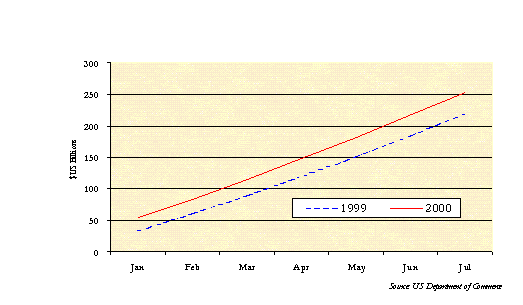
Figure
1 shows the cumulative monthly value of construction put in place for the year
to date and reflects the volume of construction work in the US. In all sectors,
these values have significantly increased in the past twelve months, with key
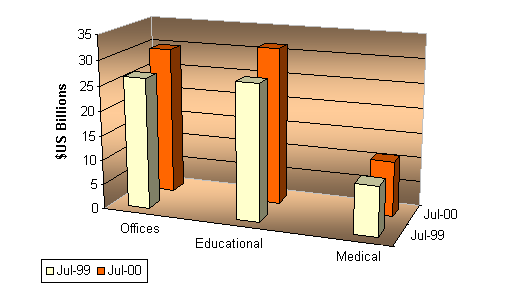
areas averaging around 9%. More telling is a look at increases in the
individual sectors, prominent amongst which are office (13% in the private
sector alone), educational (20% private, 16% overall) and medical (15% public,
11% overall) construction (fig.2).
Figure 1:
Non Residential Construction in place - 2000 YTD
Public
and private spending is at record high levels, fuelled by a thriving economy.
There is little likelihood of things slowing down in the immediate future.
Large federal and state surpluses, such as the $300 million of additional
funding authorized by Maryland State Governor Parris Glendenning for
educational projects earlier this year, are being funneled back into the various
capital expenditure programs.
Figure 2: Comparative value of
construction in place by sector, 1999 & 2000
Source: US Department of Commerce
High demand for
construction impacts many elements, chief amongst which are:
1. Bid coverage
2. Availability of construction materials
3. Availability of construction labor
4. Availability of professional services
5. Quality control
6. Contract completion
Bid coverage
Bid
coverage refers to the number of bidders for each contract and /or contract
package. The greater the number of bidders the better the price and vice-versa.
To
help understand just why this is so, imagine the procurement process as an
auction with the contract being the item for sale, albeit to the lowest rather
than the highest bidder. When the item (the project) offered for sale is rare,
more bidders (namely the Contractors) are eager to obtain the work. Competition
is strong and bid prices fall. Conversely, if the item (project) is just one of
many available, the bidding is more selective and bid coverage low. Prices go
up, as Contractors are able to pick and choose the most desirable of jobs in
terms of profit margin and reduction of risk. At the present time, demand is
outstripping supply such that many projects are having difficulty obtaining a
single bidder.
Materials costs
Increased
demand leads to supply shortfalls and/or delays, with contractors looking
further afield for suppliers or paying premiums to jump the fabrication line.
The suppliers themselves encourage this behavior (after all, they are looking
to maximize their profits too) and will often play rival projects against each
other. Those contractors who wish to circumvent this may preorder materials,
but then the cost of financing and risk is just added to the bid spread and the
price to the owner still goes up.
Labor Costs
In
a busy market, labor costs are pushed up as Contractors find themselves paying
premiums to retain labor crews. The crews need incentives to stay, otherwise
they pack up and head down the road to another contractor’s jobsite where wages
are higher or perks such as paid overtime premiums are available. A similar
situation is true of subcontractors. If you talk to any contractor at the
moment, he will complain to you of shortages in both material and labor due to
unprecedented demand. This will either cause him grief if he is endeavoring to
closeout an old project (he has his own budgets to manage) or delight if he is
explaining just why his bid is so inflated (he can charge you more money).
“Soft” costs
The
effects of high demand are not solely seen in the contracting and supply
industry. In such a market, professional services are similarly in demand, and
design fees and associated costs are also likely to increase as the consultants
pick and choose the projects they wish or have the capacity to be involved
with. Furthermore, staffing costs tend to increase, as employees are able to
“shop around” for more lucrative positions.
Other
problems
Quality
control and on time completion are also likely victims of the booming market as
contractors struggle to bring jobs in on budget whilst facing the same cost
crises outlined above. To maintain margin as costs soar, Contractors are often
forced into hiring and buying from the shallow end of the supply pool. Quality
can and does suffer as a result. Poorer quality labor and materials, and/or the
delay involved in procuring them have a negative impact on schedule. Extra and
prolonged supervisory effort adds to the cost burden and contributes to this
downward spiral.
The
additional time and effort called for from the Owners supervisory team can also
become problematic and expensive. Relationships are more prone to become
adversarial as Contractors seek to recover as much of the lost time and cost
from the Owner through claims. Consultants find themselves struggling to
balance project demands with diminishing fee balances and this too has
consequences for the Owner.
Analysis: Failure or circumstance?
Let
us turn now to the question posed earlier and synopsize the discussion presented above:
1.
Typically, the
construction cost estimate is based on a combination of historic cost data and
future predictions.
2. Current prices are up.
3. Historic costs do not change.
4.
Market conditions
have changed – demand has increased relative to market capacity (supply).
5. Demand is at unprecedented levels.
6.
The failure rate has
risen and the budget bust is real.
7. There are no guarantees when predicting the
future.
It
can be argued that in the context of construction tenders all budget overages
reflect either, or a combination, of the following:
(1)
Technical failure in terms of the execution of the estimate.
(2)
Strategic (management) failure manifested in a lack of adequate risk assessment
and associated contingency provision at budget establishment and/or lack of
control through the program development and execution.
It is difficult to comment holistically on the
individual application of estimating procedures, particularly in the absence of
detailed knowledge of the projects concerned. Experience dictates that a
proportion of the budgets in question were fundamentally flawed in their
technical execution and that their failure was inevitable. The scale of the problem (namely the
increase in failure rate or number of “budget busts” encountered) is
significant enough to imply that the industry in general, and specifically
Owners and their development teams, were caught off guard by the changing
market conditions. In not recognizing this early enough, the budget teams did
indeed fail to reflect the current market price in either its effect on
historic cost data and/or in predicting the risk of future increase. This is a
characteristic vulnerability of the public sector funding cycle. The
legislative process for fund allocation is lengthy and requires budget
establishment at an extremely early stage in the planning process, thus
increasing the lead time over which the budget team is called to predict design
development and market trends.
We can thus observe that the increased failure
rate is indicative of strategic failure in budget development and is therefore
a failure in application of budget techniques. Whilst there is inherent
uncertainty in the predictive estimate, this uncertainty should have been
quantified and managed accordingly.
There is a further scenario given that demand is
at unprecedented levels and that there are no guarantees when predicting the
future. With hindsight, it is easy to criticize and lay blame at the individual
estimators or budget teams who were proved incorrect. As risk can never be
totally removed one could argue that the budget team are blameless provided the
budget accurately reflected the costs at the time of development, that risk of
price variation was identified and management, for whatever reason, accepted a
certain degree of that risk. In this context, the market change could have been
suitably swift as to defy accurate prediction and thus is a manifestation of
the risk that was accepted. If fault is to be found in this scenario, then it
is in those budgets set that failed to take account of the true nature of the
current market once it became apparent.
The
Solution
Unfortunately,
there is no simple straightforward solution to this problem, although it is
ultimately self-resolving. We are basically paying the premium associated with
the booming US economy. At some point in the future, the market will adjust to
compensate, demand will reduce and so with it, prices. When this will happen is
difficult to determine. As long as a sufficient number of purchasers are
willing to pay the asking price and proceed with their project, demand will
continue unchecked and prices remain high.
There
are steps you can take, however, to mitigate the effect that market forces will
have on your scheme. First and foremost, establish a Cost Management procedure.
Secondly, invest in the necessary resources to implement this procedure
effectively. The following are useful techniques to apply to your situation:
Ÿ
If your project is
in design or preparing to bid:
1.
Perform detailed risk
analysis.
2.
Thoroughly research and
review the marketplace and validate your cost database.
3.
Prepare a reliable cost
model based on realistic and not purely historic data.
4.
Ensure you understand the
cost model and its basis.
5.
Review your schedule. What
is the maximum premium you are willing to pay to build at the time you wish to
build?
6.
Monitor the market and
carefully target your bid date.
7.
Keep the bid package simple
- no complex alternates and/or confusing documents.
8.
If you must have
alternates, use deduct alternates and clearly define the scope.
9.
Consider alternative
procurement approaches.
10.
Market your project.
11.
Avoid compromising the
design, but consider alternative (more readily available) materials.
12.
Use commonly accepted and
proven forms of contract. Avoid onerous contract conditions and unreasonable
requirements. Be realistic!
13.
Avoid limiting the
competition by excessive use of bidding restrictions and requirements, and/or
nominated suppliers & subcontractors.
14.
Set a realistic bid period,
not too short (precludes thorough bid compilation) or too long (bidders lose
interest, opportunity and temptation to make changes increases).
Ÿ
If your project has
bid over budget
1.
Review bid coverage - if
inadequate, solicit further bids.
2.
Talk to the bidders -
identify weakness in subcontract coverage.
3.
Review the bids. Establish
a fair and reasonable price. Determine whether you are prepared to pay the
premium.
4.
Consider postponing the
project.
5.
Consider phasing the
project and/or reducing the program.
6.
If not, and if acceptable, Value Engineer.
·
If you are trying to
close-out a project
1.
All of the above,
depending on stage of procurement.
2.
Maintain effective
quality control
3.
Be understanding of
the perspectives and motivation of the various team members involved and
promote positive cooperation.
4.
Consider incentives
e.g. bonus for timely completion
5.
Strongly enforce
your contractual rights.
Conclusion
Risk associated with fluctuations in market demand
must be addressed during budget development. Application of effective cost
management techniques using suitably skilled personnel will assist in
quantifying and somewhat mitigating the risk however contingency planning for
remedial action must be part of the project plan.
Budget
Busts:
The influence of demand in the construction market
Jonathan
Moss FRICS CCC
September
2000
List of References
The Baltimore Sun, 17 August
2000
The Washington Post, 24 August
2000
The Washington Post, 24 August
2000
ENR, 11 September 2000