Delivering Great
Design
Jonathan
Moss FRICS
CCC
LEED
Accredited Professional
January
2003
Delivering
Great Design
Jonathan Moss FRICS
CCC
Abstract
Converting
great ideas into the reality of concrete and steel, bricks and mortar, systems
and infrastructure is the fundamental challenge facing any design firm. Great
ideas are not, in themselves, great design, which can only truly be recognized
upon successful completion of a project. The cradle to grave management of the
design process to ensure that quality goals are met or exceeded on time and
within budget is quintessential to the design delivery and requires the
proactive involvement of committed, professional cost management
staff.
This
paper considers the methodology and implementation of a holistic approach to
cost management and how this is changing the business model of a top-5 A/E
provider. It addresses the basic philosophical challenges involved in such
implementation and emphasizes how success in this environment is as much a
result of the people and communication skills of the cost manager as it is his
or her technical prowess.
Introduction
From
the AIA website:
“Architects are the only
professionals who have the education, training, experience and vision to
maximize your construction dollar and ease the entire design and construction
process”
For
those of us in the field of Cost Management, such statements are amusing to say
the least. With due respect to the profession of Architect, and those
particularly who may nevertheless achieve the above ideal, it has to be said
that the Architect is not necessarily the best person to fulfill this objective.
Architecture and the process of design is, by very nature, a creative process.
Limits and constraints placed upon the creative process are therefore considered
at best, unhelpful, and are often an anathema to the black-cloaked master
designer whose wonderful and grandiose schemes take little consideration of
minor details such as budget, schedule and constructability. Experience would
indicate that perhaps, the addition of the word “expenditure” after construction
dollar, and omission of “and construction” would lead to more accuracy in the
above statement. Nonetheless converting great ideas into the reality of concrete
and steel, bricks and mortar, systems and infrastructure within the constraints
of budget, schedule and functionality is the fundamental challenge facing any
design firm.
It
would be easy at this point to jump in and claim extravagantly that we, as Cost
Managers, are the solution to the problem. Indeed, replace the word “Architect”
with “Cost Manager” and we may all suddenly find ourselves nodding in agreement
with the AIA statement. May I suggest that we, instead of being “The Answer”,
should endeavor to be facilitators of the design process, working with and
alongside the Architect and other professionals in a proactive fashion to
deliver a project?
Becoming the
Facilitator
How,
then, do we achieve this? There are several hurdles that one must
address:
The primary challenge facing the Cost
Manager is to gain acceptance and recognition as the facilitator of the process,
a proactive rather than reactive component of the project team. This can only be
done through development of a sound working relationship with key project
stakeholders on a foundation of reliable and solid advice and experience. This
is by no means a simple task, particularly for people who are happier working
with figures and documents than in face time with clients and other members of
the team. It requires great people skills and an ability to instill confidence
that what you are doing by no means encroaches or otherwise sets boundaries upon
another individuals area of particular competence and/or specialty. By
convincing team members that your participation in fact liberates them from the
more mundane side of project delivery, you will help build a more effective team
by freeing each member to focus on that which they are best at, be it planning,
design, engineering or so forth.
There
is no escaping the fact that this involves spending time getting to know the
project stakeholders, such that you can selectively lead, direct, guide, hint,
cajole and so on as personality and circumstance dictates. This is not for
everyone. Many people who attempt to fulfill this role do not possess or have
not developed the necessary skill-set. Others, who never try, would smoothly
transition into such a role in that they are natural “people” persons;
individuals who know just what to say, when to say it and to whom, who can
gently steer the ship back on course without offending, upsetting or otherwise
de-motivating the team. As Director of Cost Management in a large A/E provider,
I find that the most important item in my tool chest is the skill of diplomacy,
and the time spent away from my computer monitor dealing one on one with
stakeholders the most profitable. This may be bad news for the number crunchers
amongst us but I firmly believe that this is the way our profession must
progress.
Understanding of our own role, abilities and limitations, and those of the team are further important ingredients in achieving our goal. Recognizing the creative value of what we do is critical in empowering oneself to become proactive. (When other stakeholders recognize this in you, then you are well on the way to achieving success as a facilitator!)
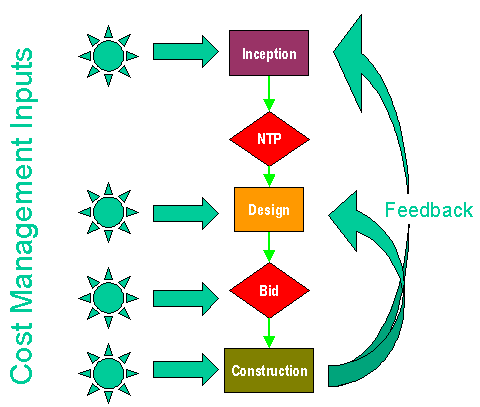
Figure 1: Outline of the Cost
Management Process
Perhaps stating the obvious (as illustrated in figure 1) to facilitate the whole process, one must be involved in the whole process. We must move away from being a second-tier consultant and endeavor to be appointed at Project inception or before; what I call Day Zero. Of course, I have a somewhat added advantage in that working for a multi- disciplinary Architectural/ Engineering/ Planning practice my team is brought in at a much earlier stage anyway. This wasn’t originally the case however, and it has taken time and effort to achieve the level of acceptance and influence to move beyond a more traditional consulting role to the situation and process described later in this paper. Nonetheless, I encourage you to take the lead and make the opportunity a reality.
Great
Design
Design Quality is
linked inextricably to a buildings craft, economy and lifespan. Understanding
the program requirements, the building systems and the delicate balance between
budget and quality will result in a facility that will respond beautifully to an
ever -changing environment.
- David King FAIA, Chairman, SmithGroup Inc.
We
hear a lot these days about “design excellence” and/or “Great Design”. Many
federal agencies have specific budgets attached to projects to enable them to
meet such criteria. We could, of course, spend many long hours investigating the
definitions and nuances of what truly constitutes greatness. At SmithGroup,
where our corporate vision is one of “achieving design excellence”, this is a
regular subject of discussion. Any single answer will find its proponents and
detractors. For the purposes of this paper, then, I will take the liberty of
adopting this simple approach:
Great design is manifested in the on-time, on- budget delivery of a project that satisfies and continues to satisfy the client’s objectives for function and quality.
In
this light, then, a great idea is not in itself great design. It is only such if
it meets the clients programmatic objectives and is ultimately delivered. An
idea that never progresses beyond the drawing board may be Art, and wonderful in
its own right, but should not be considered great design until it has been
successfully executed through construction and occupancy. A primary benefit of
this definition is that anything can therefore be considered great design
provided it meets the above criteria, and we are not trapped into a blinkered
approach that only monumental or landmark buildings constitute design
excellence.
Implementation
Let
us look now at the delivery. By my definition above, design can only achieve
greatness if it is satisfactorily delivered. Given, then, the required skill set
and appropriate opportunity, it is necessary to implement a process to deliver
this “Great Design”. Whilst my experience, and the following process, is
predominantly one of construction design and delivery, there is nothing that
precludes application of the principles outlined in this paper in other fields
of program management and delivery.
The
key in all cases is the establishment and understanding of realistic program
objectives, and in obtaining stakeholder buy-in of the
same.
The
Process
By
way of illustration, I will describe the process developed in house at
SmithGroup to facilitate such a delivery system. Let me emphasize that this
represents the new paradigm in terms of the company’s approach to doing
business. Whilst we have practiced components of the process for many years,
these were treated somewhat in isolation and never in terms of a holistic
package.
Figure
1 previously outlined an overview of the key stages in the process. For
simplicity, commissioning is considered part and parcel of construction. Move-in
and occupancy for the life cycle of the facility are ignored in the interests of
conciseness. This is not to lessen their import; indeed the ultimate performance
of the facility through its lifecycle is the key performance indicator and
primary contributor to the achievement of “greatness”.
1.
Inception
The
Cost Manager is involved in the initial response to the RFP (request for
proposal), reviewing the Clients budget expectations for schedule and cost
realism. Design proposals formulated in response are similarly reviewed, and
cost model(s), schedule and risk analysis prepared as deemed appropriate.
The
object at this point is risk mitigation, avoiding situations whereby nether
party has unrealistic expectations – the Client is not sold a scheme it cannot
afford and the A/E/P is not attempting to execute a program within unrealistic
budgetary constraints.
2.
Design
Design
can be subdivided into a programming/planning (feasibility phase) component and
an execution component (Concept through Construction
Documents).
Throughout,
the Cost Manager is an inherent part of the design process and takes a high
profile and very proactive role, particularly in the feasibility phase and
concept phase. Depending upon its size and complexity, a cost manager may be
dedicated to one particular scheme or may be involved in multiple projects. In
either case, a fundamental point is that as far as practically possible, the
same cost manager who starts the job sees it through to delivery, thereby
ensuring consistency of approach and avoiding repeated learning
curves.
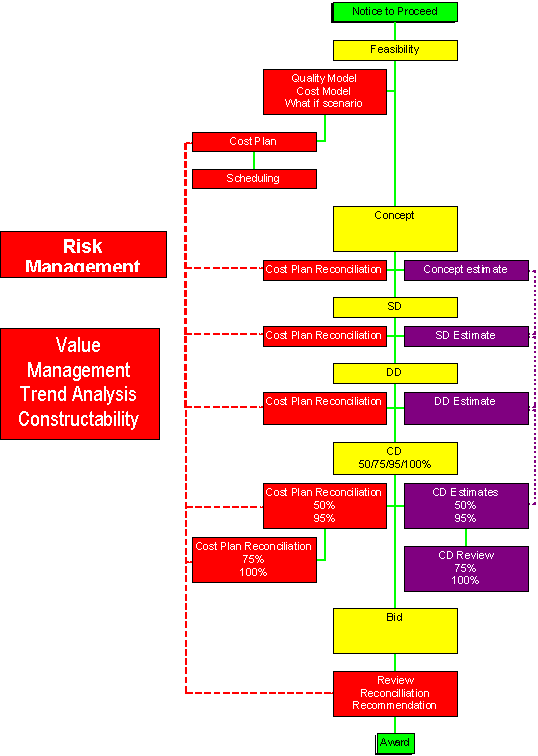
Figure
2 illustrates the various phases of the design stage for a traditional
design-bid-build approach scenario and the typical cost management
involvement. The purple boxes
represent the typical stage estimates that will be familiar to those in the
construction field. These functions may be carried out internally but are often
outsourced to estimators in keeping with the philosophy of the Cost Manager
being the facilitator of the process. This has the added advantage of bringing
external reference data for ongoing cross -checks and database maintenance. The
red boxes are the primary functions of the Cost Manager, and we emphasize the
Risk Management function that this service
provides.
Figure 2: Design Stage
A. Modeling
This
is the key effort and foundation stone of the process. We advocate the use of
interactive modeling workshops to establish performance criteria for the
execution of a project. Ideally these should be held prior to a firm budget and
scope being established, otherwise the overall benefit will be reduced. The
ultimate objective is a clear definition of project scope and production of a
baseline quality and cost model against which the design development and
implementation may be judged.
Advantages
of this approach are:
·
Clarity
of scope
·
Stakeholder
“buy-in”/engagement
·
Realistic
programming
·
Realistic
budgeting
·
Project
Control
Where
such interactive workshops are impractical or not funded, it remains in the best
interest of the project team to establish a quality and cost model for internal
control purposes. The Cost Manager facilitates/leads the workshop and will
record all quality and cost data “live”. An important goal here is to reach
consensus decision on all inputs to the quality model (categorized broadly under
the headings Resources, Operations, Image and Technology).
Workshop
success is dependant upon stakeholder buy-in on ALL such inputs. Limited
“what-if” analysis is carried out as time permits and it may prove necessary to
revisit certain parameters when inconsistencies or incompatibilities come to
light. The
outputs from the workshop are a quality model, a schedule, one or more cost
models and a preliminary program. Once validated, the program, quality and cost
models will be revisited and a cost plan established.
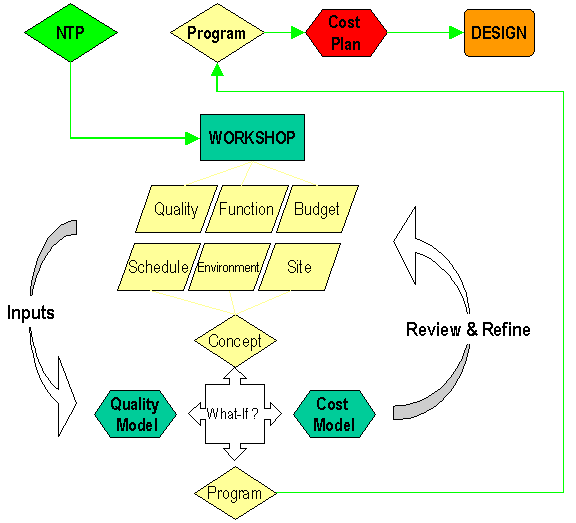
Figure 3: The
Workshop Approach
B. Cost Plan
Tied
to the program, models and scheme concept, the cost plan reflects the optimum
approach and together with the quality model will be used throughout the design
as the benchmark against which all design decisions are
measured.
C. Cost Estimates & Cost Plan Reconciliation
At key stages in the design development, snapshot estimates are taken and compared with the cost plan to confirm budget. Any variances are reconciled and if necessary, design decisions revisited.
D. Bid Review
The
cost manager is involved in the tender evaluation process to ensure best value
achieved.
E. Value Management
Not to be confused with value engineering, value management is the day-by-day involvement of the cost manager advising on best value approaches and solutions to design decisions. Value management also involves constructability review and mitigates the need for redesign due to budget busts. Similarly, it ensures that the client receives the best value implementation of the design in accordance with the functional and quality objectives embodied in the program.
F. Trend Analysis
Part and parcel of value management and cost control, this is the ongoing review of design progress to ensure quality, schedule and budgetary targets are not in jeopardy.
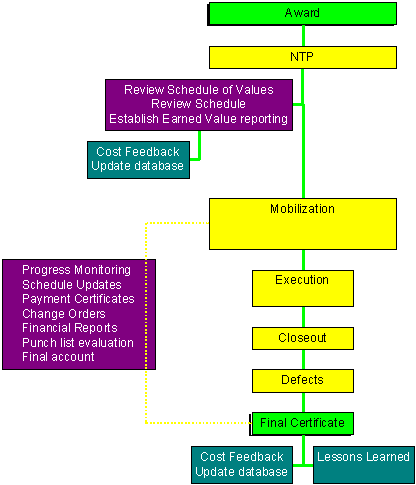
Figure 4: Construction Phase
Activity
3.
Construction
Figure
4 details Cost Management involvement during the construction phase. It is
during construction that the A/E team’s interest naturally tends to wane, for it
is hear that any weakness in their design is brought to light and some
potentially tricky problem solving may be required. The creative phase is for
the most part over and done and the designer is ready to move on to other
greater challenges. However, the construction and out working of the design
remains the critical point at which, per our earlier definition, greatness may
still be achieved and it is unwise to release the reins of control too
early.
It
is here then, that the Cost Manager may have the most to offer. The continued
involvement of the cost management team ensures continuity of purpose and
ensures that the correct focus is maintained in relation to the critical
programmatic objectives.
As “keeper of the knowledge”, the Cost
Manager is the ideal individual to work hand in hand with the Construction
Administration team in particular reference to the following
tasks:
Review
of Schedule of Values
Financial
reporting
Progress
Monitoring
Schedule
Earned
value and payment certification
Change
Orders and Claims Advice/Mitigation
Punch
List evaluation
Final
account negotiation
A
primary internal benefit to the cost management team here is the feedback and
lessons learned information that enables improvement to the quality of data and
process upon which the earlier phases rely.
4.
Occupancy
A brief note about occupancy: Design delivery is not complete until it can be demonstrated that the facility constructed is fit for its purpose and functions effectively in accordance with the initial quality goals. It is here when Client satisfaction is secured and future business obtained.
In addition to ensuring that the normal glitches and defects are corrected efficiently, continued interest in the building through its life cycle can garner useful information for feedback into the design and more particularly cost management process. Such opportunities for collecting data and lesson learning should not be missed.
Summary
& Conclusions
It
is my belief that a structured approach to cost management based upon the
proactive cradle to grave involvement of a professional Cost Manager
significantly improves the design delivery process and ensures client and
end-user satisfaction. This in itself will ultimately lead to recognition of
“Greatness” in design.
Success
in this field is dependent upon the following:
Understanding
the people involved
Understanding
the entities involved
Understanding
the project
Definition
of the criteria for success
Stakeholder
buy-in and participation
Understanding
the roles of each team member
Skillful
management of the process
Continuity
of approach
Continuity
of staff
The process outlined in this paper has already had a marked effect on the design delivery offered by SmithGroup. Stepping beyond the traditional role, the new generation of professional Cost Manager must embrace a new skill set and in so doing will become the ideal individual to facilitate delivery of great design!